This article may contain affiliate links. If you buy through them, Simply At Home may earn a small commission at no extra cost to you. Learn more.
Do this first: clear one shelf and make it the shelf where food that needs eating goes. Everything else about how I run my fridge came after that, and nothing else has cut my food waste as much. Before I had that shelf, leftovers went wherever there was room, which meant the back, which meant I found them a week later and threw them out.
My fridge is a standard rental model with three glass shelves, two drawers, and a door that does not quite seal on the top hinge if you close it too gently. It is not a large fridge and there are two of us plus whatever I have batch cooked on Sunday. A busy week is where fridge systems go to die, so the whole setup has to survive a Thursday when nobody has the energy to do anything properly.
The eat first shelf
Mine is the middle shelf, front half. Anything opened, anything cooked, anything with a short window goes there facing forward. When I open the door hungry at seven in the evening, that is what I see, and that is the entire mechanism. It works because it removes a decision rather than adding a rule.
I keep a shallow open bin on that shelf so the whole zone can be pulled out and looked into. Containers pushed to the back of a glass shelf are invisible. Containers in a bin come forward as a group and go back as a group, and nothing gets stranded behind the milk.
Put things where the temperature suits them
A fridge is not one temperature. Cold air sinks and the door swings in and out of a warm kitchen all day, so the top of the door is the warmest spot in the appliance and the back of the bottom shelf is the coldest. Storing food against that gradient rather than with it is why things spoil early.
- Door: condiments, jams, anything heavily salted or acidic. Not milk and not eggs, whatever the molded egg tray suggests. Both prefer steady cold.
- Top shelf: leftovers, cooked food, drinks. The temperature is even here and nothing raw is dripping from above.
- Middle shelf: dairy, and my eat first bin.
- Bottom shelf: raw meat and fish, always on a rimmed plate or tray. This is the coldest spot and it is also the only place where a leak cannot land on something you eat uncooked.
- Drawers: produce, split by humidity if your drawers have a slider.
The drawer sliders are not decoration
I ignored those little vents for years. They control humidity, and the rule is short enough to memorize: things that rot want airflow, things that wilt want humidity. So the closed drawer holds greens, herbs, carrots, and lettuce, and the open drawer holds apples, pears, and anything that gives off ethylene gas and speeds up its neighbors.
Keeping apples out of the greens drawer bought me several extra days of usable lettuce, which I would not have believed until I tried it deliberately for a couple of weeks.
Prep only as far as you will actually go
I used to wash and chop everything on Sunday and then watch half of it go slimy by Wednesday. Washed produce holds moisture and moisture is what breaks it down. Now I wash on the day I use it, with two exceptions that have earned their spot.
Greens get washed, spun properly dry, and stored in a container with a dry paper towel, because a bag of unwashed spinach is a bag of spinach I will not eat. And carrots and celery get cut into sticks and kept in water, because cut vegetables in a visible container are the only snack in the house that competes with crackers.
The prep that survives the week is the prep that removes one specific obstacle. Everything else is Sunday optimism.
Containers that let you see in
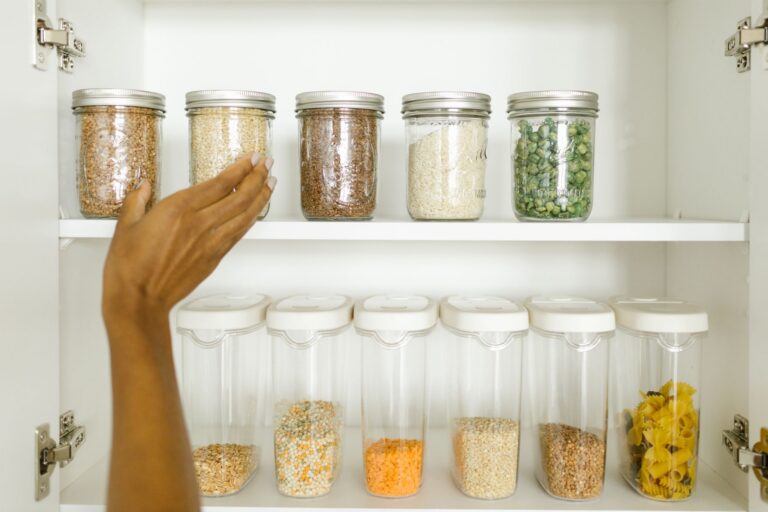
Opaque containers are how leftovers become a science experiment. If I cannot see what is in it, I will not open it, and if I do not open it, I will throw it out on Saturday. Clear sides solved most of that on their own.
Where clear is not possible, masking tape and a pencil on the lid with the food and the date takes four seconds. I do not use a fancy labeling system. I write rice, Tuesday, and that is enough information for anyone in the house to make a decision.
Cool things down before they go in
A hot pot placed straight into the fridge raises the temperature of everything around it while it cools, which is bad for the milk sitting next to it. I let food sit out until it stops steaming, no more than an hour or two, then divide it into shallow containers rather than one deep one. Shallow food chills through quickly. A deep container of soup stays warm in the middle for hours.
The Thursday sweep
Once a week, before the grocery run, I take four or five minutes and pull everything forward. Not a clean out, just a look. Anything questionable gets used that night or goes in the bin. Anything sticky gets a wipe with a damp cloth while the shelf is briefly clear.
I do this on Thursday rather than Sunday on purpose. Doing it right before shopping means I buy against what is actually in there, and it means the fridge is at its emptiest when the new food arrives. Sunday sweeps happen after the fridge is already full, which is too late to be useful.
What holds up on a bad week
The parts of this that survive a genuinely bad week are the eat first bin and the placement rules, because neither requires effort in the moment. You put the leftovers in the bin instead of on the shelf. You put the raw chicken on the bottom instead of the top. That is it, and it happens whether or not you have any energy left.
The parts that fall apart are the ambitious ones, the Sunday chopping and the perfectly labeled stacks. I have made peace with that. A fridge that works on your worst Thursday is worth more than one that looks organized on your best Sunday.