This article may contain affiliate links. If you buy through them, Simply At Home may earn a small commission at no extra cost to you. Learn more.
Start with the four things that actually go bad, and leave everything else in the bag it came in. That is the short version of what I believe about decanting after several years of doing it wrong in both directions, first pouring nothing into anything, then pouring everything into matching jars I had to wash constantly.
Decanting is the practice of moving food out of its packaging into your own container. It photographs beautifully and it solves a couple of real problems. It also creates problems that nobody mentions, and the balance between the two depends entirely on which food you are talking about.
What decanting is genuinely good for
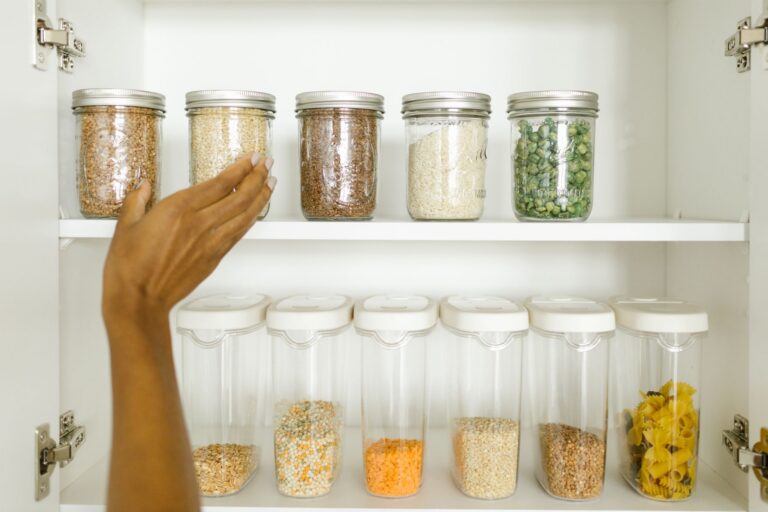
Three benefits, and they are worth taking seriously. Airtight storage slows staling and keeps pests out, which matters enormously for flour and grains. Uniform containers stack and use vertical space that floppy bags waste. And a clear container tells you how much is left without opening anything, which is the reason I stopped buying duplicate rice.
In my kitchen the difference showed up most in the bottom of the pantry. Bags of flour and sugar used to slump against each other and shed a fine dust over everything below them. Two square canisters ended that, and the shelf under them stopped needing a wipe every month.
The four I always decant
- Flour. It goes stale, it attracts pantry moths, and an open paper bag folded over with a clip is not a seal. This is the single highest value decant in any kitchen.
- Sugar. Mostly for clumping and for the mess. Brown sugar especially, which turns into a brick in its original bag faster than you expect.
- Rice and other grains. Bulk bags are unwieldy and impossible to scoop from cleanly. A wide mouth container you can get a measuring cup into changes how often you cook them.
- Oats. Same reason as rice. The cardboard cylinder is tall, tips over, and does not seal.
That is the list. Everything past those four is negotiable, and most of it I have decided against.
What I stopped decanting, and why
Cereal was the first thing to go back into its box. The canister meant I lost the date and the nutrition panel, and the box already stands up on its own. I was solving a problem I did not have.
Pasta was the second. It comes in a sealed bag or box that is already reasonably tidy, it does not go stale in any timeframe I can perceive, and the cooking time is printed on the packaging. I have overcooked enough decanted pasta to know I do not reliably remember whether something is eight minutes or eleven.
Anything I buy less than three times a year is not worth a container either. Cornmeal, specialty flours, the bag of dried mushrooms. They go in a low open bin together, in their own packaging, and I pull the whole bin out when I need something from it.
The real cost of decanting is not the jar. It is the washing, the drying, and the ten seconds of transfer every single time you buy that item again.
The date and instruction problem, solved cheaply
The main argument against decanting is that you throw away information. Best by date, cooking directions, lot number if there is ever a recall. This is a fair objection and it has an easy fix that took me too long to adopt.
I cut the panel off the bag with kitchen scissors and drop it into the container with the food, or tape it to the underside of the lid. Ten seconds. For flour and sugar I just write the month and year on a strip of masking tape on the side of the jar. That covers everything I have ever actually needed to know.
Choosing containers without buying twice
Measure the clear height between your shelves before anything else. Fixed pantry shelves often give you eleven or twelve inches, and a lot of canisters sold as pantry canisters are taller than that. I have owned a set that did not fit and I do not recommend the experience.
Beyond height, three things matter. Square or rectangular containers use noticeably more of a shelf than round ones, because round containers waste the corners. A wide mouth you can fit a measuring cup into is worth more than any other feature, since a narrow neck means pouring and pouring means spilling. And a lid that seals with a gasket or a clamp is the only kind that does the job for flour, because a friction lid is not airtight no matter how firmly it clicks.
On material, glass shows you the level clearly and does not hold odors, but it is heavy and it breaks if you keep it above shoulder height. Plastic is lighter and safer up high, and a good quality one is fine for dry goods. I use glass on the low shelves and plastic above eye level, which is less about aesthetics than about what happens when something slips.
Do not decant into a dirty or damp container
This is the mistake that ruins food rather than merely wasting effort. A container that is even slightly damp inside will clump flour and can grow mold in oats. After washing, I leave containers upside down on a towel overnight before they get filled. If you are in a hurry, dry the inside with a clean cloth and then leave it open on the counter for an hour.
I also do not top up. When a flour canister gets low, I finish it, wash it, dry it, and then pour in the new bag. Adding fresh flour on top of old flour means the old stuff sits at the bottom indefinitely, and after a long enough time down there it starts to taste like the inside of a cabinet.
A reasonable place to land
If you are starting from nothing, buy two containers, not twelve. Flour and sugar. Live with them for a month and see whether you find yourself wishing a third thing had one. That is a much better signal than a shopping list written before you know how your own kitchen behaves.
My pantry has six decanted containers total and a lot of bags and boxes standing in bins behind them. It does not look like a showroom. It does mean that the four things that would otherwise go stale or attract pests are sealed, and that I can see at a glance whether I need rice, which is genuinely all I wanted from the exercise.