This article may contain affiliate links. If you buy through them, Simply At Home may earn a small commission at no extra cost to you. Learn more.
If your towels have stopped drying you, the towels are probably fine. Something is coating them. I spent a long stretch buying replacement towels every couple of years, convinced that towels just wear out, before I understood that mine were being slowly waterproofed by the things I was putting in the wash. My house has hard water, which made the whole problem faster and more obvious, but soft water houses get there too. It just takes longer.
The short version: cotton towels absorb water because the fibers are open and thirsty. Fabric softener works by depositing a thin waxy film on fibers so they feel slick. Those two facts are in direct conflict, and the film wins.
Do this first: pull the softener out of the towel load
Before you strip anything, before you buy anything, stop adding fabric softener and dryer sheets to towels. That single change fixes most towel complaints on its own within three or four washes, because each wash removes a little of the buildup that is already there.
I keep dryer sheets in the house for exactly one purpose, which is static in fleece during the dry months. They never touch a towel. Liquid softener I stopped buying entirely, and I have not missed it.
If you want towels to feel softer without a coating, the honest answers are: wash them in enough water, do not overload the drum, and tumble dry them rather than line drying them. That is most of it.
How to strip towels that are already coated
Stripping is a one time reset, not a routine. I do it when I move into a place, when I inherit towels from someone, or when a set has clearly gone slick and stiff at the same time, which is the signature of buildup.
My method:
- Wash 1. Hot water, no detergent, one cup of white vinegar in the fabric softener dispenser. Vinegar is mildly acidic and helps release the softener film and some mineral deposit.
- Wash 2. Hot water, half a cup of baking soda tossed directly into the drum, no detergent. This is a separate cycle. Do not combine it with the vinegar wash, because the two neutralize each other and you end up with salty water and nothing else.
- Wash 3. Normal detergent, normal cycle, extra rinse. This clears whatever the first two loosened.
- Dry. Medium heat, all the way through, no dryer sheet.
You will notice a difference immediately in how fast a towel takes up water. The test I use is simple: hold a towel flat and pour a splash of water on it. A working towel swallows it. A coated towel lets it bead and roll off the surface for a second before it soaks in.
A towel that beads water is not a worn out towel. It is a towel wearing a raincoat you gave it.
The hard water part
Mineral heavy water leaves deposits in fibers the same way it leaves them on a shower door. Combined with detergent, those minerals form a residue that stiffens fabric and traps odor. If your towels smell faintly sour when they get damp even though they came out of the wash clean, that is usually mineral and detergent residue holding onto bacteria, not a dirty machine.
Two things helped in my house:
- Use less detergent, not more. This feels backwards. Hard water does reduce detergent effectiveness, but the fix is a detergent formulated for it, not a double dose of the regular stuff. Excess detergent does not rinse out and becomes part of the residue.
- Add a water softening booster to the towel load. Washing soda or a commercial laundry booster keeps minerals in suspension so they rinse away instead of settling into the cotton.
I also run an extra rinse on every towel load. It costs a few minutes and a little water and it makes a real difference in how the towels feel a week later.
Washing towels well, week after week
Once the reset is done, the maintenance is boring, which is what you want.
Wash towels alone. Mixing towels with clothing does both jobs badly. Towels are heavy and lint heavy, clothes are not, and the cycle that suits one does not suit the other. Towels also need more water than a mixed load usually gets.
Warm water, not hot, for regular loads. Hot every single time shortens the life of the fibers and the stitching. I use warm for the weekly wash and save hot for a stripping wash or a sickness in the house.
Half a drum, not a full one. This is the mistake I made longest. Towels swell when they get wet. A drum packed dry is a drum with no room for water movement once everything is saturated, and the towels come out having essentially soaked in their own dirty water. I wash four bath towels and a few hand towels at a time in a standard machine, and that is it.
Dry all the way through, then stop. Damp towels folded into a closet is how a linen closet starts to smell. Over drying, on the other hand, cooks the fibers brittle and creates most of the lint you find in the screen. I use medium heat and pull them the moment they are dry rather than running a full extra cycle to be safe.
How often, honestly
A bath towel used by one person, hung so it actually dries between uses, is fine for three or four uses. That last part is the whole condition. A towel folded in half over a bar dries on the outside and stays damp in the middle, and a damp towel starts growing things by the second day.
I switched every towel bar in my house to a single hook or a wide bar where a towel can hang open. It is less tidy looking than a neatly folded towel and it doubled how long a towel stays fresh. Hand towels in a busy bathroom go in the wash every two or three days because everyone uses them and nobody hangs them properly.
When a towel really is finished
Cotton terry does eventually give up. The loops flatten, the edges fray, and no amount of stripping brings the loft back. The signs I look for:
- The pile is visibly matted flat in the middle where hands and bodies rub, and it stays flat after a wash and dry.
- The hem is separating and the towel is shedding threads into every load.
- It smells musty within hours of coming out of the dryer, after a full strip has already been tried.
Retired towels move to the garage in my house. I cut the good sections into rags for the car and for painting, and the frayed sections go out. I do not keep retired towels in the linen closet, because a towel in the linen closet will eventually get used as a towel, and then somebody is drying off with a rag.
A small storage note
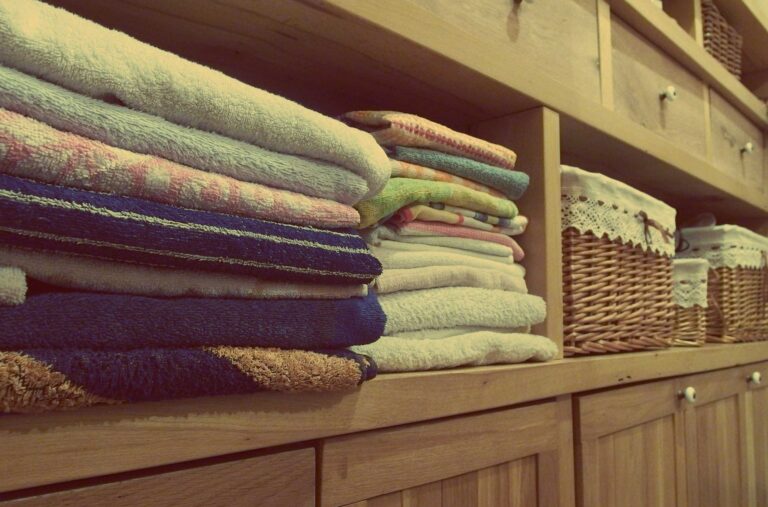
Fold towels the same way every time and store them in a single stack per size. Mixed stacks of bath towels, hand towels, and washcloths turn into archaeology, and people pull from the middle and knock the stack over, and then the towels live on the shelf sideways getting dusty.
I also stopped storing towels in a bathroom that has no window and no fan running. That closet held humidity and everything in it smelled faintly of the shower. Now the bulk lives in the hallway linen closet and only the towels in current rotation are in the bathroom.
None of this is complicated. It is mostly a matter of taking one thing out of the process, adding one rinse, and giving the towels room to move. My current set is coming up on five years and still dries me off properly, which is the only performance metric a towel has.