This article may contain affiliate links. If you buy through them, Simply At Home may earn a small commission at no extra cost to you. Learn more.
Pull every cleaning product you own into one place before you buy or throw out anything. I did this on a Saturday morning two years ago and ended up with thirty one bottles, cans, and jars spread across the kitchen floor, which was roughly twenty five more than I have ever needed. Four of them were duplicates I had bought because I could not find the original. Two had solidified. One was a spray for a surface material that does not exist anywhere in this house.
I now keep six products and one basket of cloths. Cleaning got faster immediately, not because the products are better, but because I stopped standing in front of a cabinet making decisions. Choosing a cleaner is a tiny cognitive cost that you pay every single time you clean, and paying it thirty times a week adds up to a real drag on whether you start at all.
The six that survived
I am not going to name brands, partly because what is available where you live differs and partly because the specific bottle matters far less than the category. What matters is that each of these does a job the others cannot, and together they cover everything in a normal house.
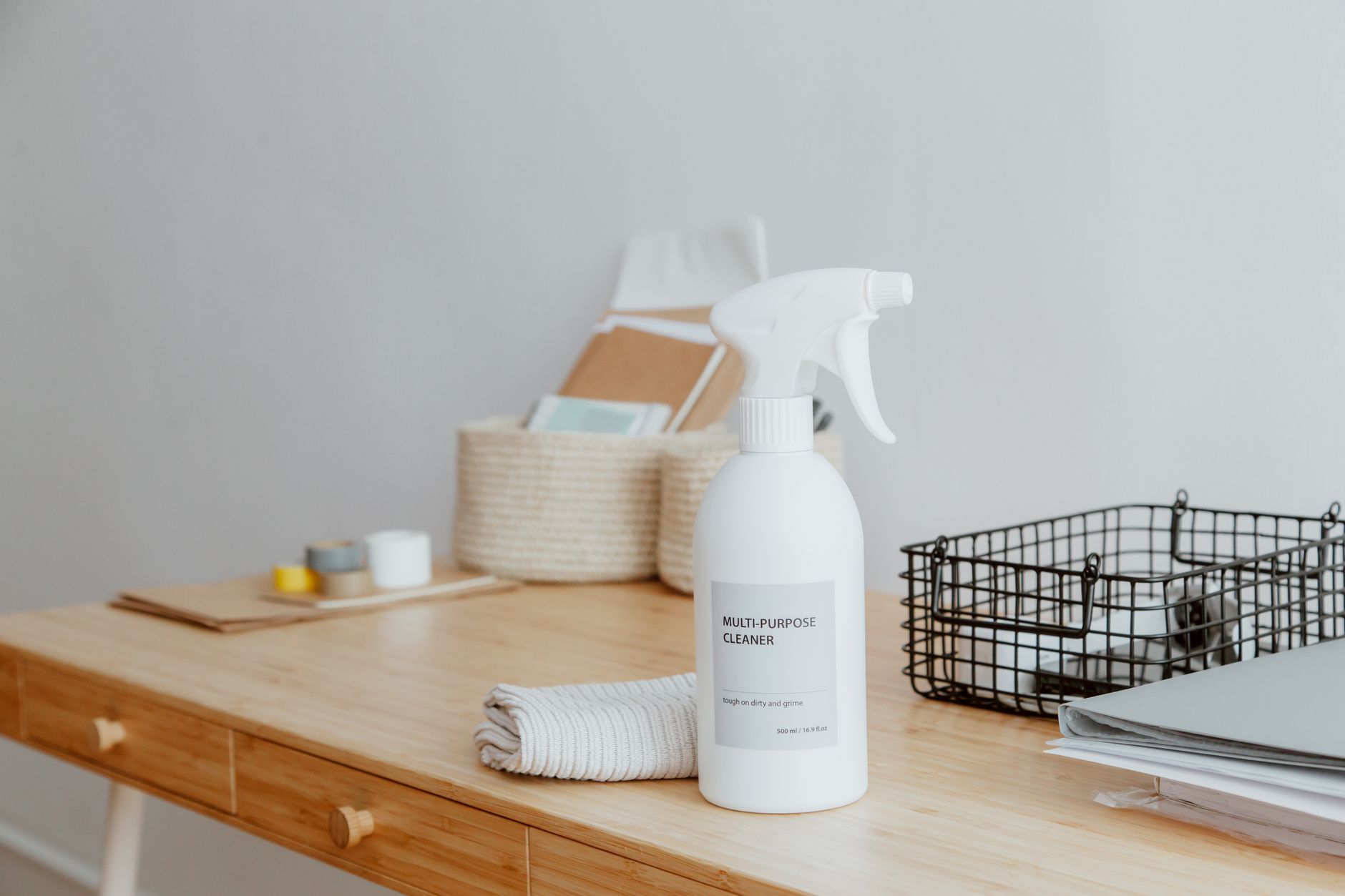
- All purpose spray. Counters, tables, appliance fronts, light switches, the outside of the toilet, most walls. This is the workhorse and it handles the large majority of what I clean.
- Glass cleaner. Mirrors, windows, the glass on the oven door, and the shower door. You can technically use all purpose plus a dry cloth, and I did for a while, but glass is the one place where the specialist product genuinely saves time.
- A creamy mild abrasive. For the sink, cooktop rings, the tub, and any place where something has bonded to the surface. This is the product that replaced about five things I used to own.
- A bathroom cleaner with real cutting power. Soap scum and hard water deposits do not respond to all purpose spray, and pretending otherwise just means scrubbing longer.
- Dish soap. Which doubles as a hand wash for delicate items, a spot treatment for grease on fabric, and a floor cleaner when diluted heavily.
- A disinfectant. Used narrowly and rarely: cutting boards after raw meat, the bathroom during an illness, the trash can when I wash it out. Not for daily surfaces.
That is the list. Everything else I threw out or gave away, and in two years I have missed exactly one thing, which was a wood floor cleaner, and I bought it back. Six plus one is a fine landing spot.
Cloths do more work than products
The single biggest improvement in my cleaning was not a product change. It was owning enough cloths that I never have to reuse a dirty one out of scarcity.
I keep about twenty microfiber cloths in a shallow basket in the laundry room, sorted loosely by use. Blue for general surfaces, white for glass and mirrors, and a handful of ragged older ones for jobs I would rather not put a good cloth through, like wiping out the grill pan or dealing with something the dog did.
Color coding sounds fussy. It is not, and it takes zero extra effort once the cloths are bought. It exists so I never wipe a counter with the cloth that did the toilet, which is a real risk when everything is the same shade of gray and half of them are damp.
Wash them without ruining them
Microfiber loses its grab if you run it with fabric softener or dry it on high heat, because the softener coats the fibers and the heat melts them slightly. I wash mine together in a warm load with regular detergent and no softener, then dry on low or hang them over the utility sink. A cloth treated this way lasts me a couple of years. A cloth run through a softener load feels slick and pushes dirt around instead of picking it up.
Where to keep them
Under the sink of the room where they are used, at the front, with nothing in front of them. I have written about this before because it is the change with the highest return relative to effort of anything I have done to my cleaning.
For a couple of years my supplies lived in one bin in the laundry room, which is at the back of the house past the kitchen. Any cleaning job started with a trip to fetch the bin. That trip is maybe forty seconds and it killed perhaps a third of my intentions, because forty seconds is enough time to remember something else that needs doing.
Duplicating a bottle of all purpose spray so there is one upstairs and one down costs very little. Compare it against the number of counters that get wiped because the bottle was right there, and it is not close.
Tools, kept to a similar minimum
The product list is only half of it. Tools sprawl the same way and matter more, because a bad tool makes a job take twice as long regardless of what you spray on it.
- A vacuum you can carry up stairs without planning ahead
- A broom and a dustpan with a rubber lip that actually meets the floor
- A flat mop with washable pads rather than a string mop and bucket
- Two scrub brushes, one stiff and one soft
- A squeegee for the shower
- A stepladder that lives somewhere reachable
The dustpan lip is worth a sentence of its own. I used a cheap one with a warped edge for years and left a line of dust behind every single sweep, then re swept it, then gave up and pushed it under the fridge. A dustpan whose edge sits flat against the floor eliminated that whole ritual.
How to actually do the purge
Set aside forty minutes and work in one pass. Gather everything into one spot, including the bottles under the bathroom sink, the ones in the garage, and whatever is living in the back of the linen closet. Seeing the full inventory at once is the part that does the persuading.
Then sort into four groups on the floor:
- Keep. Products you have used in the last three months and would buy again.
- Duplicate. Second and third bottles of something you already keep. Consolidate into one bottle where the product allows, otherwise keep the fuller one and pass the rest along.
- Dead. Separated, hardened, crusted around the nozzle, or from a house you moved out of. These go.
- Unsure. Anything you cannot decide about.
Put the unsure group in a box, label it with the date, and set it somewhere out of the way. If you have not gone into that box in three months, get rid of it without opening it. Opening it restarts the deliberation you already paid for once.
Disposal, done properly
Do not pour concentrated cleaners down the drain in a batch, and do not mix products together in a bucket to consolidate the trip. Some combinations produce fumes you very much do not want in a small room, and drain cleaner in particular should never share a container with anything.
Most areas have a household hazardous waste drop off, often at a transfer station or on scheduled collection days. Check what yours accepts before you load the car. Anything mild and heavily water based, like most all purpose sprays, is generally fine diluted down the drain, but the aggressive stuff belongs at the drop off.
What changed after
The cabinet under my kitchen sink now holds one spray bottle, dish soap, a box of bags, and nothing else. I can reach the spray without moving anything and I can see the whole space with the door open.
The measurable difference is that I wipe the counters more often. Not because I became more disciplined, but because the friction went from four steps to one. Almost every cleaning habit I have fixed has come down to that same move: find the four seconds of resistance and remove them, then watch the behavior change on its own.