This article may contain affiliate links. If you buy through them, Simply At Home may earn a small commission at no extra cost to you. Learn more.
Start with the sink. Everything else in a nightly reset flows from that one decision, and I learned it the hard way after a couple of years of waking up to a kitchen that felt like an accusation. My house was built in 1962 and the kitchen is narrow enough that two people cannot pass each other without turning sideways, so a single stack of dirty pans blocks the entire room. Once I made the sink the anchor, the rest of the routine organized itself around it.
The whole thing takes about fifteen minutes. Some nights it takes eight. On the nights when everyone has been home all day it can stretch toward twenty, but it has never once turned into an hour, because the point of a reset is not to clean the house. The point is to return the house to a known starting position so tomorrow does not begin in a hole.
Why the night shift wins
I tried the morning version first. Get up a little earlier, deal with last night’s mess, start the day clean. It failed within two weeks, and the reason was simple: in the morning I am negotiating with a schedule. There is a clock running and other people need things from me. Any task that can slip will slip.
At night nothing is chasing me. The work is already done, the day is closed, and the only thing competing with the reset is my own desire to sit down. That is a much easier opponent than a school run. I also found that the mess is fresher at night. Sauce that has been on a counter for twenty minutes wipes off. Sauce that has sat overnight needs a scraper and a grudge.
The other advantage is emotional and I will not pretend otherwise. Walking into a settled kitchen at six in the morning changes how the first hour of the day feels. It is a small gift you hand to a version of yourself who is going to be tired and unreasonable.
The order I work in
Order matters more than speed here. If you wander, you will double back and burn the fifteen minutes without finishing anything. I move in the same loop every night, and because it is the same loop, I barely have to think.
One: sink and counters
Dishes go into the dishwasher or get washed. Anything that will not fit gets rinsed and stacked to the left of the faucet in a deliberate pile rather than a random one, because a deliberate pile reads as a plan and a random pile reads as a failure. Then I wipe the counters from the back edge toward the front, sweeping crumbs into my hand rather than onto the floor.
The last move is the sink itself. I rinse it, run a cloth around the basin, and dry the rim. Drying the rim is the piece people skip and it is the piece that makes the kitchen look finished instead of merely emptied.
Two: the flat surface sweep
I carry a basket through the living room and the hall and pick up anything that does not live there. Mail, socks, a screwdriver from a project three days old, the water glasses that migrate to every horizontal surface in this house. I do not put things away as I find them. I collect first, then distribute, because walking a single sock to a bedroom and coming back is how fifteen minutes becomes forty.
- Coffee table clear except for the remote and one book
- Dining table completely clear, no exceptions, because it is the surface that attracts everything
- Kitchen island down to the fruit bowl
- Entry bench down to bare wood
Those four surfaces are my whole standard. If they are clear, the downstairs reads as clean even if the baseboards have not been touched in a month. I am not being cynical about that. Perception is most of what a home does for you day to day.
Three: floors, middles only
I sweep or run the vacuum over the traffic paths and nothing else. The middle of the kitchen, the run from the back door to the table, the strip of hallway carpet everyone actually walks on. Edges and corners belong to the weekly rotation, not to a nightly reset. Trying to do them at night is how the routine dies.
A reset is maintenance, not cleaning. The moment you start improving things instead of returning them to baseline, you have quietly signed up for a job you will quit.
What I deliberately leave undone
This list is as important as the work itself. Every one of these things has tried to sneak into my nightly routine and every one of them got evicted.
- The inside of the microwave
- Wiping down cabinet fronts
- Anything involving a stepladder
- Folding laundry that is already out of the dryer and not in anyone’s way
- Sorting the mail beyond putting it in one spot
- The bathroom, apart from hanging up a dropped towel
I keep a short list on a sticky note inside a cabinet door of things I notice at night and want to handle later. Writing it down is the trick that lets me walk past it. If it is captured, my brain stops circling it.
Supplies stay where the work happens
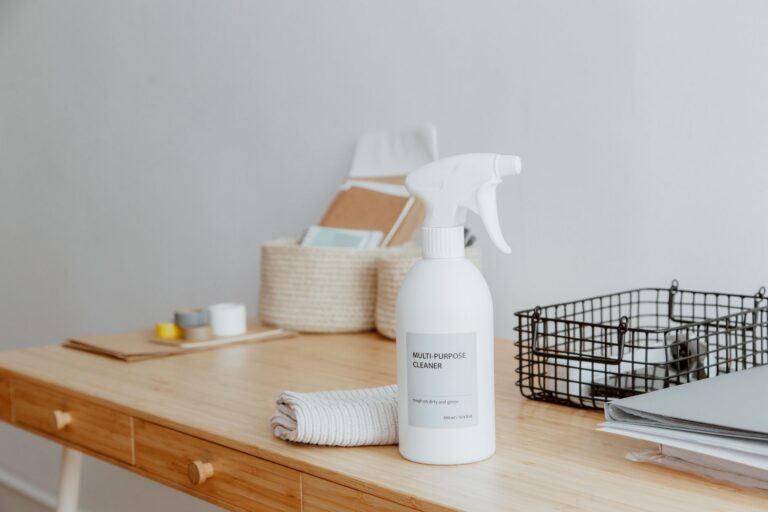
I do not carry a caddy for this. A caddy is for a real cleaning session. For the reset I keep exactly three things within arm’s reach of the kitchen sink: a stack of folded cloths in the drawer to the right, a spray bottle of all purpose cleaner under the sink at the front where I do not have to move anything to reach it, and the broom hanging on the inside of the pantry door.
The front of the cabinet detail sounds trivial. It is not. When I had to move a bucket and a box of bags to reach the spray bottle, I skipped the counters roughly a third of the time. Reducing that reach to one motion fixed the compliance problem completely, which taught me something I now apply everywhere: if I keep failing to do a small task, the obstacle is usually physical and about four seconds long.
Making it survive a bad night
Some nights I have nothing left. The routine has to have a floor version or it will break entirely, and a broken routine is much harder to restart than a shrunken one.
My floor version is three moves and takes about four minutes. Dishes into the dishwasher and run it, even if it is not full. Wipe the counters. Clear the dining table into the basket and leave the basket by the stairs. That is it. Nothing else. I go to bed.
The morning after a floor version is not as good as the morning after a full reset, but it is not a disaster either, and critically the routine is still alive. Streaks matter more than quality with this kind of habit. I have watched a perfect two week run collapse because one exhausted Tuesday turned into permission to stop, so now I aim for the four minute version rather than nothing.
Getting other people into it
My husband works later than I do and he took a while to see the point. What eventually worked was not a lecture. It was assigning him the sink and only the sink, on the nights he is home before I finish. He does that part well and I stopped commenting on the rest.
Handing over a whole routine fails because the other person inherits your entire mental model along with the work. Handing over one bounded piece works, because the piece is legible. Sink, done, walk away. After a few months he started clearing the table too, unprompted, which I have learned not to remark on out loud.
The first week
If you are starting cold, do not run the full loop on night one. Do the sink for four nights and nothing else. Let it get boring. Then add counters. Then add the surface sweep. Then add floors. Adding one piece every few nights means you are always doing something that already feels automatic plus one new thing, which is a load your tired self will actually accept.
The measure of success is not a spotless house. It is that the first ten minutes of your morning stop being spent on yesterday.