This article may contain affiliate links. If you buy through them, Simply At Home may earn a small commission at no extra cost to you. Learn more.
Start with an empty shelf. Not a tidier shelf, not a shelf with the front row pushed back into line, but a shelf holding nothing at all, with everything that used to live on it sitting in a pile on the floor. Every storage project I have finished and stayed happy with started that way. Every one that fell apart within a month started with a shopping trip instead.
I learned this the expensive way in a house built in 1958, which means shallow closets, one linen cupboard for the whole upstairs, and a hallway cabinet that somebody clearly built for canned goods and nothing else. My first instinct in that house was to buy containers. I bought nine of them. Six went back to the store, and the three I kept are still holding the wrong things.
Why the bin comes last
A container is a decision made physical. It says this much of this category lives here, in this shape, at this height. You cannot make that decision honestly while the category is still spread across four rooms and partly hidden behind a stack of dish towels. When you shop first, you are guessing at volume, and people guess high. That is how a closet ends up with a beautiful matched set of boxes that are two thirds empty and still somehow not enough.
There is a second problem. Buying storage feels like progress, so it satisfies the part of you that wanted to fix the mess. You get the small hit of having done something, the boxes go into the closet, and the sorting never happens. The mess is now inside opaque containers, which is worse than the mess on a shelf, because at least the shelf was honest with you.
The forty minute version
You do not need a weekend. One shelf, one drawer, or one cabinet section is a complete project. Here is the order I use, and I have not found a shortcut that beats it:
- Clear a staging surface first. A bed, a dining table, a clean patch of floor. If you skip this you will end up sorting into the space you are trying to empty.
- Take everything off. Everything, including the thing you know you are keeping. Seeing the empty space is part of the work.
- Wipe the empty shelf. It takes ninety seconds and it changes how you feel about putting things back.
- Sort the pile into four groups before you evaluate anything individually.
- Put the keepers back with no containers at all, arranged the way you actually reach for them.
- Live with it for a week or two. Then, and only then, measure and buy.
That last step is the one people skip, and it is the one doing the most work. A week of using the shelf tells you which things you grab daily, which ones tip over, and which category has quietly doubled since you last looked.
Four groups, not two
Keep and toss is too blunt. It forces a verdict on things you have no strong feeling about, and when a decision feels heavy, people stop sorting and start rearranging. I use four groups:
Keep here
Things you use in this room, at roughly this frequency. Not things you might use, not things that are good quality. Things you have actually reached for in this space.
Belongs elsewhere
This pile is always bigger than expected and it is the fastest win in the whole process. Half of what clutters a shelf is not clutter at all, it is homeless items from other rooms. Put them in a laundry basket and do one lap of the house at the end, not one trip per item.
Out
Donate, recycle, trash, or return. Bag it and get it into the car the same day if you can. A donation bag that sits by the door for three weeks is just clutter in a different costume, and I say that as somebody who once drove around with a bag of picture frames in the trunk from spring until the following winter.
Undecided
The pile that ruins people. It grows to absorb every hard call, and then it goes back on the shelf and the whole exercise is undone.
The undecided pile needs a rule, not more thinking
The rule I use is simple. The undecided pile goes into one box, the box gets today’s date written on the side in marker, and it goes somewhere out of the daily path. A closet floor, the top of a wardrobe, a corner of the basement. If I open the box for something within six months, that item graduates back into the house. If the six months pass and I have not opened it, the whole box leaves without being reopened, because reopening it just restarts the deliberation.
The date matters more than the deadline. A box with a date on it is a decision waiting to happen. A box without one is furniture.
One caveat that I have made peace with: sentimental things do not belong in this box. They are not undecided, they are keepers with no assigned home, and they need a different conversation on a different day. Mixing them in stalls the whole sort, because you will sit down with a shoebox of letters and lose the afternoon.
Put things back naked
When the keep pile goes back on the empty shelf, resist the urge to corral anything. Set items down loose, in the arrangement your hands want. Tall things at the back if the shelf is deep, daily things at the front edge, heavy things low. Look at what happens over the next week.
What you are looking for is the shape of the problem. Do things fall over, which means you want dividers rather than bins. Do small items migrate and get lost, which means you want a shallow tray, not a deep box. Do you have to move three items to reach a fourth, which means the shelf is too deep and you want a pull out or a front to back file arrangement instead of stacking.
Those are four different purchases, and no amount of standing in a store aisle will tell you which one you need. A week of use tells you in about four seconds.
What my hallway cabinet taught me
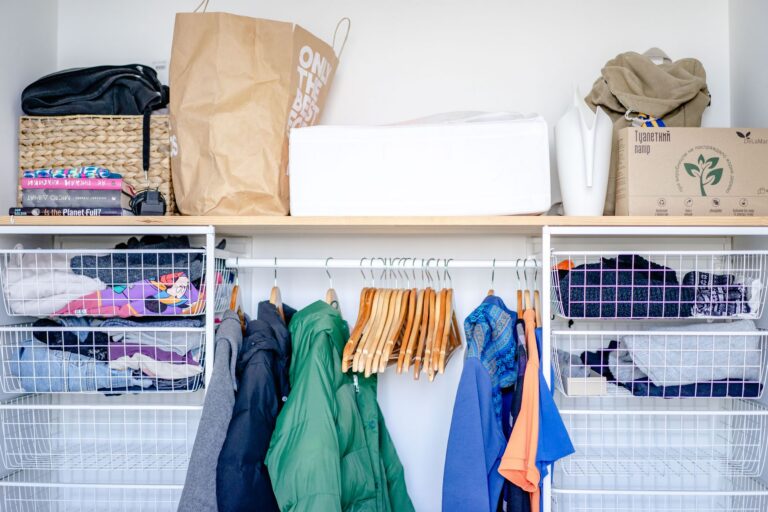
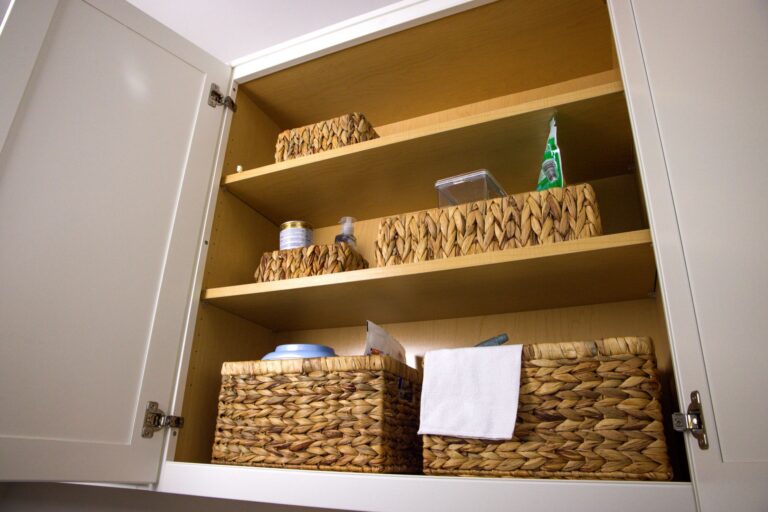
My hallway cabinet held, at the point I finally emptied it, the following: three partial packs of batteries, a hair dryer nobody used, five reusable shopping bags, two lightbulbs of a type we no longer own a fixture for, a shoebox of cables, a first aid kit, sunscreen, and a spare doorknob. My assumption going in was that I needed baskets. What I actually needed was to admit that the cabinet was serving as an overflow zone for six unrelated categories, and that no basket fixes a category problem.
The batteries and lightbulbs became a household supplies drawer somewhere else entirely. The bags moved to a hook near the back door, which is where we were already dropping them. The hair dryer left. What remained fit on one shelf with room to spare, and the one thing I eventually bought was a single shallow tray for the first aid supplies, because those were the items that scattered.
The container is the last five percent of a storage project. When it feels like the first step, that is usually a sign you are avoiding the sorting.
When you do finally buy
Buy for the space you have measured and the volume you have already seen, and buy one before you buy six. Take the single container home, load it, and use it for a few days. If it works, go back for the rest. If it does not, you have returned one item instead of a set, and you have learned something specific about your shelf depth or your reach or the way your family puts things away.
I also try to buy things that stay useful if the plan changes. Open trays, simple rectangular bins in one or two sizes, and dividers get reassigned easily. Custom molded organizers built for one exact category almost never do, and they turn into their own small storage problem the day that category changes.
Keeping the shelf honest
A sorted shelf drifts. That is normal and not a personal failing. The maintenance move that works for me is leaving one visible gap, about the width of a hand, on every shelf I have sorted. When the gap closes, something has arrived that does not have a home, and it is time for a ten minute pass rather than a full afternoon.
Do this first, before anything else, the next time a cabinet frustrates you: take one shelf, empty it completely onto the floor, and wipe it down. You will know within ten minutes whether you have a storage problem or a sorting problem. It is almost always the second one.